Table of Contents
You made a mistake years ago. You served your time, paid your fines, and moved on with your life. But every time you fill out a job application, that familiar dread returns. If you are wondering, "How far back do background checks go?" you are not alone. The answer dictates whether you can finally breathe easy or if you need to take legal action to protect your career.
The most common misconception is that a background check goes back infinitely, uncovering every minor indiscretion from your teenage years to the present day. In reality, federal and state laws place strict limitations on what Consumer Reporting Agencies (CRAs)—the companies employers hire to run background checks—are legally allowed to report.
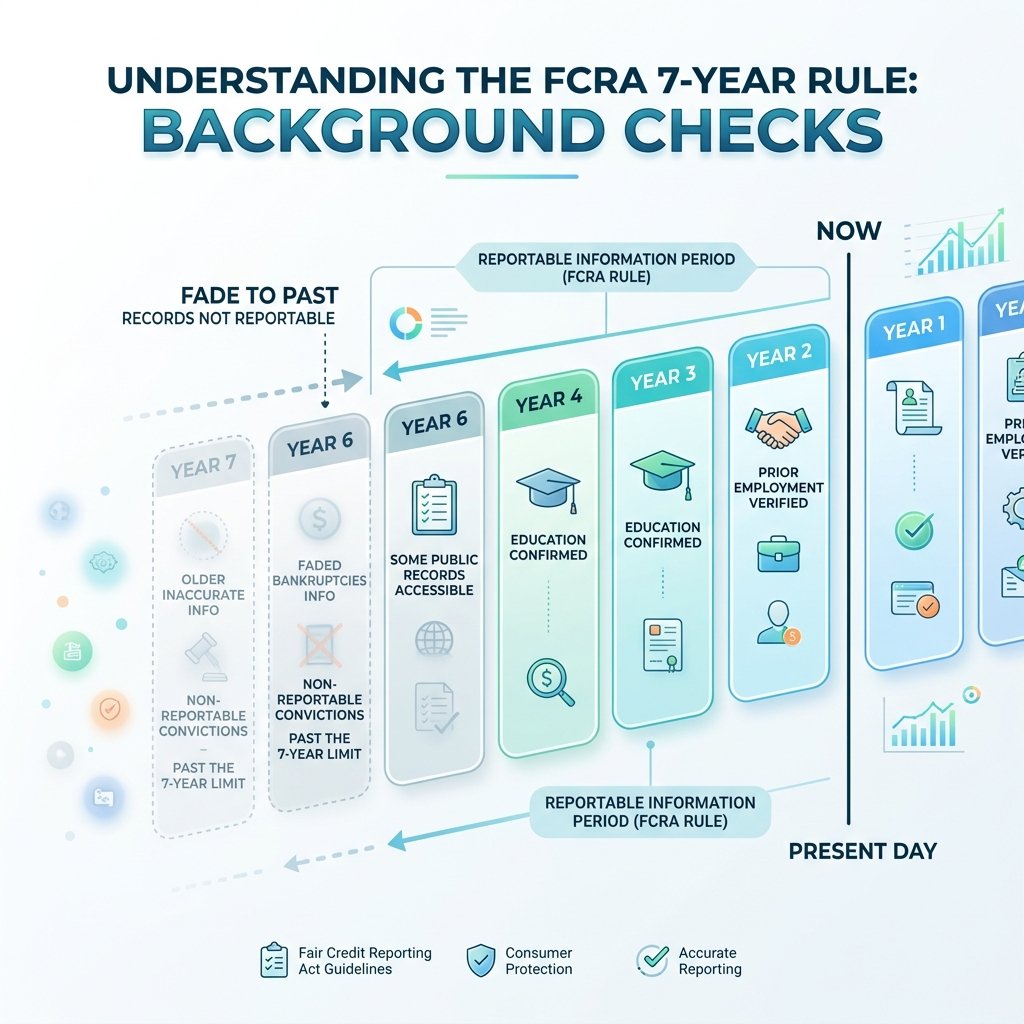
The Foundation: The FCRA and the 7-Year Rule
The primary law governing employment background checks in the United States is the Fair Credit Reporting Act (FCRA). While it has "Credit" in the title, it applies to almost all third-party background screening.
Under the FCRA, there is a general 7-Year Rule for adverse information. This means that a CRA cannot report negative information that is older than seven years.
Here is how the 7-Year Rule applies to different types of records under federal law:
- Arrests that did not lead to a conviction: Cannot be reported after 7 years.
- Civil lawsuits and judgments: Cannot be reported after 7 years (or until the governing statute of limitations expires, whichever is longer).
- Paid tax liens: Cannot be reported after 7 years.
- Accounts in collection: Cannot be reported after 7 years.
However, there is a massive loophole in the federal FCRA regarding criminal convictions: Federal law allows criminal convictions to be reported indefinitely. Yes, under the strict letter of the FCRA, a felony conviction from 20 years ago can still legally appear on a background check.
But before you panic, you must understand state laws and industry standards, which heavily modify this federal baseline.
Don't wait out the clock.
Instead of hoping a 7-year-old charge won't show up, legally remove it. Check if you are eligible for expungement right now.
Check Expungement EligibilityWhen Does the 7-Year Clock Start?
For arrests that did not lead to a conviction, the 7-year clock starts ticking on the date of the arrest.
If an employer runs a background check in 2026, and you had an arrest (that was dismissed) in 2018, that arrest is older than seven years and cannot be legally reported by a background check company under the FCRA. If they do report it, they are in violation of federal law, and you have the right to dispute the report and demand its removal.
Exceptions: When the 7-Year Rule Doesn't Apply
As mentioned above, the federal 7-year rule does not apply to criminal convictions. If you were found guilty, pled guilty, or pled no contest, the federal FCRA allows that conviction to be reported forever.
Furthermore, the 7-year rule does not apply to background checks run by the government for security clearances, law enforcement jobs, or jobs involving vulnerable populations (like childcare or elder care). In these scenarios, investigators have access to your entire life history, regardless of how much time has passed.
The $75,000 Salary Exception
There is a little-known clause in the FCRA that voids the 7-year protection entirely if you are applying for a job with an expected annual salary of $75,000 or more.
If you are applying for an executive, senior management, or high-paying technical role, the background check company is legally permitted to report non-conviction arrests, civil judgments, and paid tax liens that are older than seven years. As salaries have inflated over the decades since the FCRA was written, this $75k threshold traps an increasingly large number of applicants.
How State Laws Provide Extra Protection
Because the federal FCRA is relatively weak regarding convictions, many progressive states have passed their own, stricter versions of the FCRA. When a state law offers more protection to a consumer than the federal law, the background check company must follow the state law.
States known as "7-Year States" restrict background check companies from reporting any criminal record (including convictions) that is older than seven years. Notable 7-year states include:
- California
- Colorado
- Kansas
- Maryland
- Massachusetts
- Montana
- New York
- Texas
- Washington
If you live in one of these states, your conviction is generally hidden from standard employers after seven years (though exceptions still apply for specific industries and salary levels). However, if you live in a state without these extra protections, your conviction can haunt you indefinitely.
Cleaning Up Your Record Regardless of Age
Relying on the 7-year rule is a passive and risky strategy. You are banking on the background check company understanding and following complex, overlapping state and federal laws—which they frequently fail to do.
The only guaranteed way to ensure an arrest or conviction does not appear on a background check is to obtain a legal expungement or record sealing.
Once a judge signs an expungement order, that record is legally destroyed. It does not matter if the employer is paying you $20,000 or $200,000, or if you live in a 7-year state or not. An expunged record cannot be reported by a CRA, and you are not legally required to disclose it in an interview.
Take control of your background check.
Stop wondering what an employer might find. Find out exactly what is on your record and if it can be legally erased today.